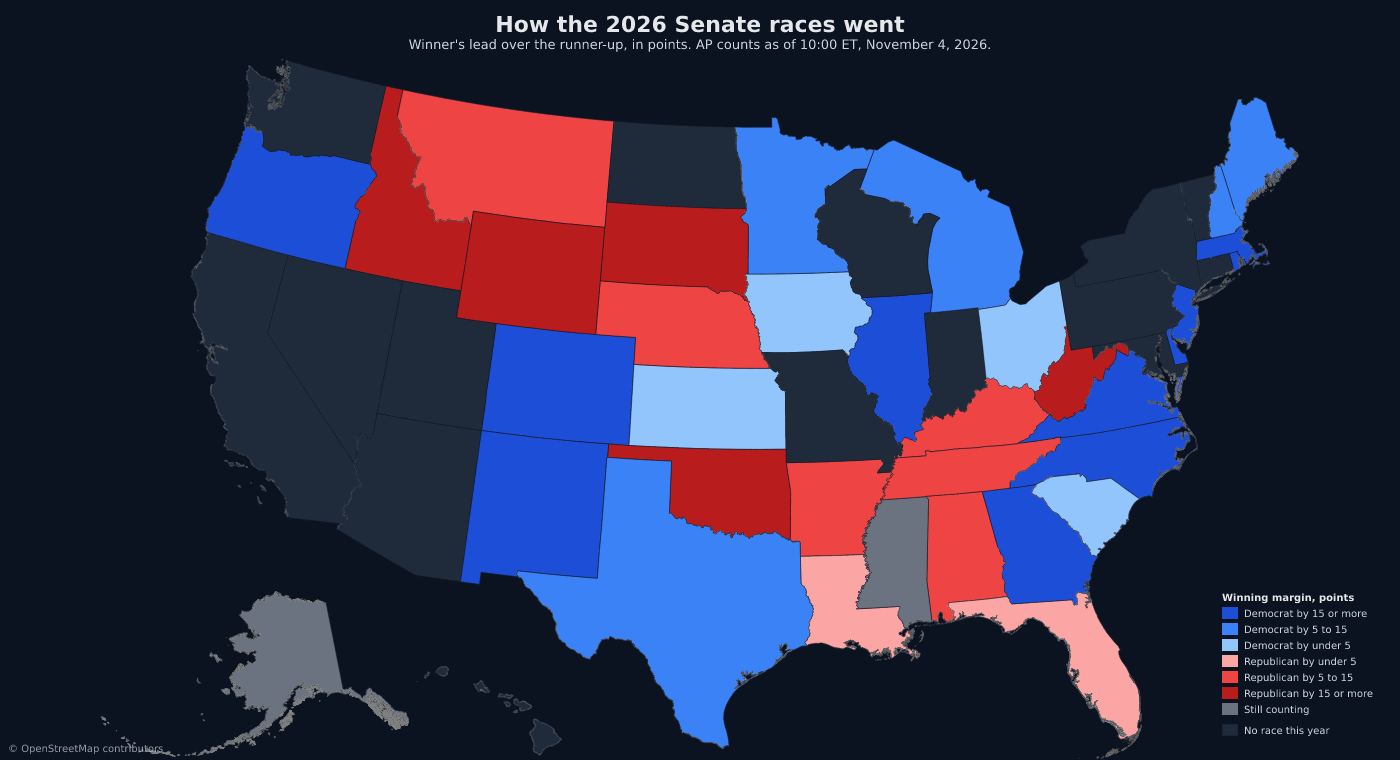
Seven Senate seats flipped. All seven the same way.
Welcome to Mapped — one dataset turned into one map, every week. This week, a day after the vote: how the 2026 midterms went, state by state.
This is a live post. The Senate and governor maps use the counts published at 10:00 ET on November 4, the morning after the vote; the House map and seat count use the 02:27 ET update on November 7. We will update them as the remaining races are called: the Alaska and Mississippi Senate seats, the Kansas and Alaska governor races, and the last House districts. Every edit is logged in What’s changed at the end. Last updated: November 7, 2026.
Thirty-five Senate seats were up on November 3. Seven changed hands, and all seven went from Republican to Democrat. None went the other way. With Alaska and Mississippi still counting, Democrats hold 54 seats to the Republicans’ 44, up from 47 before the election, counting the two independents who sit with them.
The map shows the winning margin in each Senate race, in points, as counted on the morning after.

Remix this map → Opens this exact map in the editor, data included. Change the numbers, the palette, the country. It’s your copy.
What you’re looking at
Blue states elected a Democrat, red states a Republican. The darker the colour, the wider the margin: under 5 points, 5 to 15, or more than 15. Grey states are still counting, and the unshaded ones had no Senate race this year.
The seven flips. Texas is the biggest: James Talarico beat Ken Paxton by 12.1 points, the first Democrat to win a Texas Senate race since Lloyd Bentsen in 1988. North Carolina went to former governor Roy Cooper by 19.6. In Maine, Troy Jackson beat Susan Collins, a senator since 1997, by 7.7. The other four are the pale blue on the map: Sherrod Brown took Ohio by 4.8, Adam Hamilton Kansas by 4.8, Annie Andrews South Carolina by 4.4 and Josh Turek Iowa by 4.1.
The pale red. Republicans held Louisiana by 1.8 points and Florida by 2.9. Alabama, Arkansas, Kentucky and Tennessee were held by 9 to 13. Only five states, Wyoming, Idaho, South Dakota, West Virginia and Oklahoma, gave a Republican more than 15 points. Eleven states gave a Democrat that much.
The two grey states. In Mississippi, Democrat Scott Colom led Senator Cindy Hyde-Smith by 43 votes with 96 percent of the vote counted. In Alaska, Mary Peltola led Senator Dan Sullivan by 0.3 points with a quarter of the vote still out. Neither race had been called on Wednesday morning. By 02:27 ET on November 7, Colom’s lead had grown to 0.3 points with 97 percent counted, Peltola’s was unchanged at 0.3 with Alaska still counting, and neither race had been called. The map keeps the Wednesday-morning counts until they are.
A note on four red states: in Idaho, Montana, Nebraska and South Dakota the runner-up was an independent, not a Democrat, so the margin there is the Republican’s lead over the independent. Dan Osborn held Pete Ricketts to 6.7 points in Nebraska.
The governors
Thirty-six states also chose a governor. Five flipped, again all from Republican to Democrat: Texas, where Gina Hinojosa beat Greg Abbott by 7.1; Ohio, where Amy Acton beat Vivek Ramaswamy by 7.9; Georgia (8.6), Nevada (7.5) and Iowa (11.0). Democrats now hold at least 28 of the 50 governorships, a majority for the first time since 2010. Kansas, where Cindy Holscher led by 0.6 points, and Alaska, whose ranked-choice count was still to run, were undecided, and still were on November 7.

Reading the map. A governor runs a state’s government. It is a separate job from the state’s two senators, and the governor’s race is a separate contest on the same ballot, so Texas voted twice on November 3: once for a senator, once for a governor. The 36 states that chose a governor this year are coloured by who won that race and by how much: blue for a Democrat, red for a Republican, pale for a win of under 5 points, mid for 5 to 15, dark for more than 15. Grey with stripes is a race not yet called. The 14 unshaded states did not hold a governor race this year. Texas is mid blue: Hinojosa by 7.1. Florida is pale red, won by 1.3. Wyoming is dark red, won by 51.8; California is dark blue, won by 28.0.
The pale red here is in the South and New England: Republicans held Florida by 1.3 points, Tennessee by 2.5, New Hampshire by 3.9 and Alabama by 4.2, where Tommy Tuberville beat former senator Doug Jones. Vermont’s Phil Scott, the last Republican governor in New England, won by 7.0.
The House
Democrats also won the House. By 02:27 ET on November 7, NBC News had called 252 seats for the Democrats and 162 for the Republicans, with 21 still to be called, and estimated the Democrats would finish with 259 of the 435 to the Republicans’ 176. Republicans held 218 before the election.
maproll draws states, not the 435 districts, so the third map shows each state’s delegation: which party won more of its House seats, and how many.

Blue states sent more Democrats than Republicans, red states more Republicans. The darkest shade is a clean sweep, every seat in the state. The middle shade is two-thirds or more of the seats, the pale one a plain majority. Purple is an even split. Grey, striped states have enough seats still to be called that the lead could flip. Hover a state for its count.
Clean sweeps only show up in small delegations, nine seats or fewer. Nine states elected only Democrats: Massachusetts, Connecticut, Nevada, New Mexico, New Hampshire, Rhode Island, Hawaii, Delaware and Vermont. Seven elected only Republicans: Oklahoma, Arkansas, Idaho, West Virginia, North Dakota, South Dakota and Wyoming. The big states are pale: Texas sent 14 Democrats and 24 Republicans, all called, Florida 7 and 17 with four seats open. California has 46 Democrats to 2 Republicans called with four open: the middle shade, because 46 of 52 seats is short of a sweep.
Where the delegations moved, on seats called so far. Against the delegations elected in 2024, North Carolina went from 4 Democrats and 10 Republicans to 9 and 2 with three seats open. Pennsylvania went from 7 and 10 to 11 and 6. Iowa, where Republicans held all four seats, now has 3 Democrats. Ohio went from 5 and 10 to 8 and 7, Wisconsin from 2 and 6 to 4 and 4, and New York from 19 and 7 to 20 and 6. Texas barely moved, from 13 and 25 to 14 and 24. Several states, Texas, Missouri, North Carolina, Ohio and California among them, redrew their districts in 2025, so some of this is new lines rather than new votes.
Two purple states, four grey. Wisconsin, 4 and 4, and Montana, 1 and 1, are even splits with nothing left to count. In four states the seats still open could flip the lead: Louisiana, where Democrats have 1 seat to the Republicans’ 3 with two open, Maine, 1 to 0 with one open, Minnesota, 4 to 3 with one open, and Alaska, whose single seat has not been called. On November 4 nine states were grey; Ohio, Nebraska, Arizona, Colorado, South Carolina, Utah and Montana have since been called far enough to take a colour.
The takeaway
Every seat that changed hands changed in the same direction: seven in the Senate, five governorships, and the House majority. The margins say how far it went. Of the 13 Senate races Republicans won, five were by more than 15 points. Of the 20 Democrats won, eleven were.
Make this map yourself
The whole map is one maproll URL. Each state carries its margin and its colour:
https://api.maproll.io/map.svg?scope=US
  &data=US-TX:12.1:%231d4ed8,US-OH:4.8:%2393c5fd,US-WY:-30.4:%23b91c1c,...
  &theme=dark
  &legendItems=%231d4ed8:Democrat%20by%2015%20or%20more;%2393c5fd:Democrat%20by%20under%205;...
  &title=How%20the%202026%20Senate%20races%20went
The legend is yours too: legendItems=%231d4ed8:Democrat%20by%2015%20or%20more;... lists the colours and labels in the order you want. Drop the colours and the legend and add colorScale=diverging for the automatic two-sided scale, or paste next week’s counts over these. Remix this map → or start from scratch.
What’s changed
This post is updated as races are called. Each entry gives the time of the counts it used.
- November 7, 2026. House map and seat count moved to NBC’s calls as of 02:27 ET: 252 Democrats, 162 Republicans, 21 uncalled, from 238, 146 and 51. Seventeen states changed. Montana finished 1 and 1 and joined Wisconsin in purple; Nevada became the ninth Democratic sweep; Ohio, Nebraska, Arizona, Colorado, South Carolina, Utah and Montana left the grey group; Texas, New York, New Jersey, Michigan, Virginia and Tennessee were fully called or down to one seat. Senate and governor maps unchanged: no new calls, Mississippi lead noted as 0.3 points.
- November 4, 2026, afternoon. House map and seat count added, using NBC’s calls as of 14:00 ET (238 Democrats, 146 Republicans, 51 uncalled). A fourth map, the Senate swing since 2020, was dropped as too hard to read. The “Reading the map” note under the governor map was added.
- November 4, 2026, morning. Published with the Senate and governor maps, using AP counts as of 10:00 ET.
Sources: vote counts from the Associated Press as published by NBC News (governors) and Fox News, as of 10:00 ET on November 4, 2026; House seat calls and per-state counts from NBC News as of 02:27 ET on November 7, 2026; race calls per NBC News. Margins are the winner’s lead over the runner-up, rounded to one decimal, and will move as counting finishes. Seat tallies before the election from the Senate, gubernatorial and House election pages on Wikipedia; 2024 House delegations from the 2024 House elections page. Next week on Mapped: subscribe below to get it first.