Japan's grid has been split in two since the 1890s
Welcome to Mapped: one dataset turned into one map, every week. This week: the frequency of the electricity in your wall.
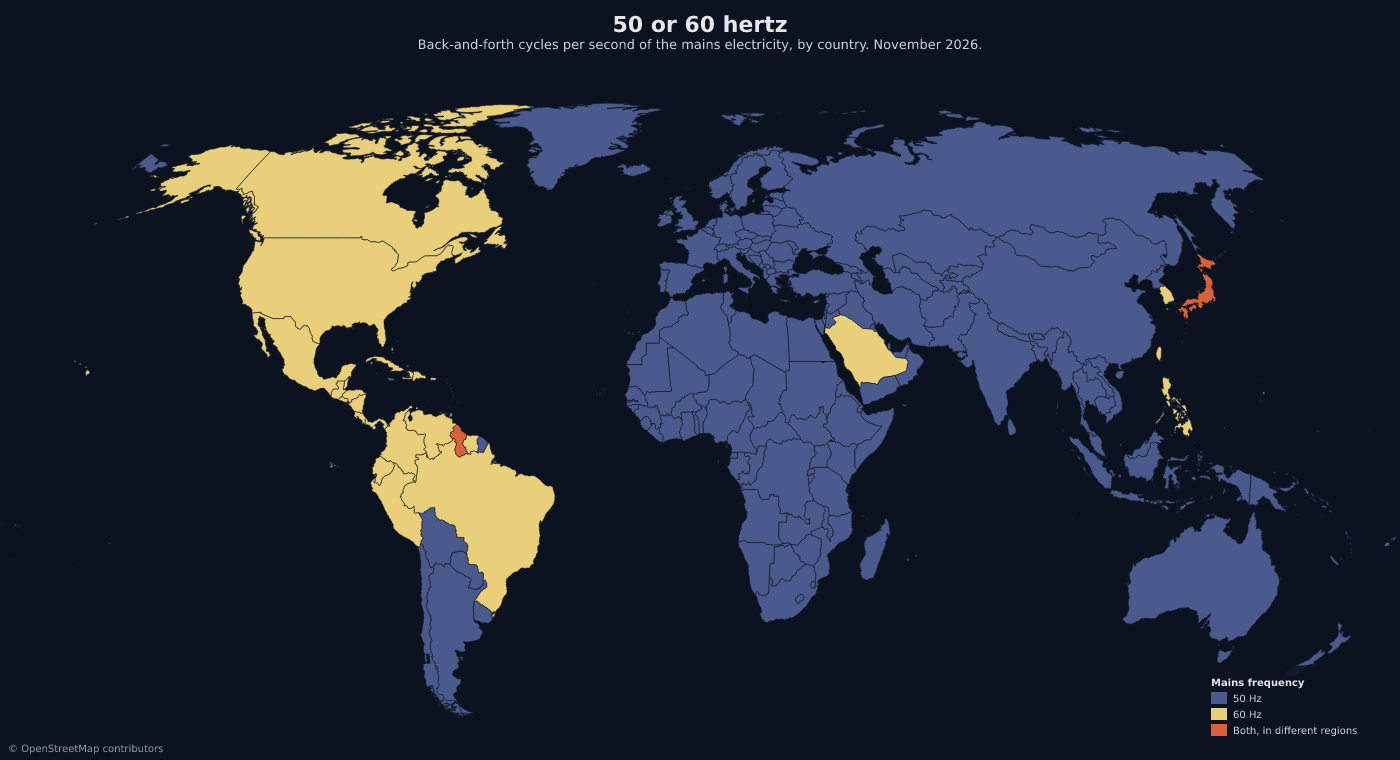
The electricity in a wall socket doesn’t flow one way. It swings back and forth, and every power grid picks how fast. In most of the world it makes 50 back-and-forth cycles a second: 50 hertz. In most of the Americas it’s 60.
Japan uses both. Tokyo and the east run at 50 Hz, Osaka and the west at 60. The line between them follows two rivers, and it goes back to two purchases in the 1890s: Tokyo’s power company bought German generators, Osaka’s bought American ones.

Remix this map → Opens this exact map in the editor, data included. Recolour it, change a country, add your own. It’s your copy.
What you’re looking at
The frequency of the public grid, country by country. Both means the public grid runs at 50 Hz in some regions and 60 Hz in others. A factory or a private island with its own generator doesn’t count.
The split is mostly by continent. 60 Hz covers North and Central America, much of the Caribbean, and South America’s north, plus Peru and Brazil. Outside the Americas it reaches Saudi Arabia, South Korea, Taiwan, the Philippines and a few Pacific islands tied to the US. Everywhere else, from Europe and Africa to China, India and Australia, runs at 50 Hz.
Why two numbers
Early electric companies picked their own frequencies, anything from 25 to 133 hertz. Two of them won. In Germany, AEG had settled on 50 Hz by 1891: a round number, and fast enough that electric lights didn’t visibly flicker. In the United States, Westinghouse went to 60 Hz, which suited its arc lamps. Each standard spread with the company’s equipment and its trading partners.
Switching later is rare and expensive. Every generator on a grid spins in step with its frequency, and motors, transformers and clocks are built for it too. A switch means replacing or rewinding all of that.
Japan: one country, two grids
In 1895 and 1896, Tokyo Electric Light bought 50 Hz generators from AEG. In Osaka, the local company bought a 60 Hz generator from General Electric. Each city’s grid grew outward until the two met, roughly along the Fuji River on the Pacific side and the Itoigawa on the Sea of Japan. Plans to unify the country on one frequency came and went in the first half of the 20th century.
On the public grid, power crosses the line through frequency converter stations. The first was built at Sakuma in 1965. In March 2011 the stations could move only about 1 gigawatt, and that limit mattered: the earthquake and tsunami knocked out about 27 gigawatts of generation in the east. Tokyo had rolling blackouts. Since then the link has doubled, to 2.1 gigawatts across four stations.
Japan is expanding the link to 3 gigawatts. The work was due by 2027. The grid operator OCCTO now expects it in December 2028, after storm damage and land purchases.
Japan also has the lowest mains voltage of any country, 100 volts.
Itaipu: one dam, two frequencies
Itaipu, one of the world’s largest hydroelectric dams, sits on the border between Brazil (60 Hz) and Paraguay (50 Hz). Each country owns half. So of its 20 generators, 10 run at 50 Hz and 10 at 60 Hz, driven by the same turbine design.
Paraguay uses only part of its half. The rest is sold to Brazil, but it can’t go straight onto a 60 Hz grid. It is converted to direct current and sent about 800 km on a high-voltage direct-current (HVDC) line to a converter station near São Paulo, where it is turned back into 60 Hz alternating current.
The 60 Hz islands outside the Americas
Saudi Arabia is the only large 60 Hz grid in the Middle East, a legacy of the American equipment that came with Aramco. It connects to its 50 Hz neighbours through one 1,800 MW converter station, opened in 2009. South Korea, Taiwan and the Philippines are 60 Hz too.
Liberia is the odd case. Older references list it as 60 Hz, an American legacy. But the grid rebuilt after the civil war runs at 50 Hz, and it now imports power from its 50 Hz neighbours. We map it as 50.
Still mixed, or recently mixed
- Guyana’s power company has described its supply as “both 50 and 60 cycle”. Part of Georgetown was still on 50 Hz when conversion to 60 began in 2009, and the company hasn’t published when, or whether, it finished.
- The Caribbean Netherlands is split by island: Bonaire runs at 50 Hz, Saba and Sint Eustatius at 60.
- Mexico City ran at 50 Hz until the 1970s, and Brazil was mixed until a 1964 law put it on 60. Parts of Southern California ran at 50 Hz until 1948.
- Ontario ran much of its grid at 25 Hz until a conversion that began in 1949. Amtrak still runs part of its Northeast Corridor on 25 Hz power, and the railways of Germany, Austria and Switzerland use their own 16.7 Hz grid.
The six-minute clock
In many places, grid frequency also keeps time. Many oven and alarm clocks count the cycles of the mains, 50 or 60 a second, so a grid that runs slow makes them slow.
In early 2018 a dispute between Serbia and Kosovo over who should pay for power left the continental European grid running at an average of about 49.996 Hz for weeks. That’s 0.008% below 50. By March, clocks across Europe that count the cycles had fallen about six minutes behind. Grid operators then ran slightly fast to win the time back.
The takeaway
Roughly speaking, the world’s electricity is still split along the sales territories of the 1890s: German in most of the world, American in most of the Americas. And Japan is still divided, more than a century after Tokyo and Osaka each picked a supplier.
Make this map yourself
The whole map is one maproll URL. Each country gets a class and a colour:
https://api.maproll.io/map.svg?scope=world
  &data=US:2:#e9cf7a,BR:2:#e9cf7a,JP:3:#d9603b,DE:1:#4a5a8c,...
  &legendItems=#4a5a8c:50 Hz;#e9cf7a:60 Hz;#d9603b:Both, in different regions
  &theme=dark
Remix this map → or start from scratch.
Sources: country frequencies from WorldStandards (updated September 2025), cross-checked against Wikipedia, utilities and regulators. History: Neidhöfer, “50-Hz frequency”, IEEE Power & Energy Magazine, 2011. Japan: Japan Times (2011), IEEE Spectrum, OCCTO progress report (October 2025), Sakuma IEEE Milestone. Itaipu: HVDC Itaipu. Saudi Arabia: SERA Grid Code (2024). Liberia: USAID/IRG report. Guyana: Stabroek News, Guyana Times (2024). Ontario: Brock University Library. Amtrak: Amtrak’s 25 Hz traction power system. European clocks: ENTSO-E (March 2018). French Polynesia is mapped as both (Tahiti 60 Hz, the Marquesas reportedly 50 Hz) on thin evidence. Next week on Mapped: subscribe below to get it first.