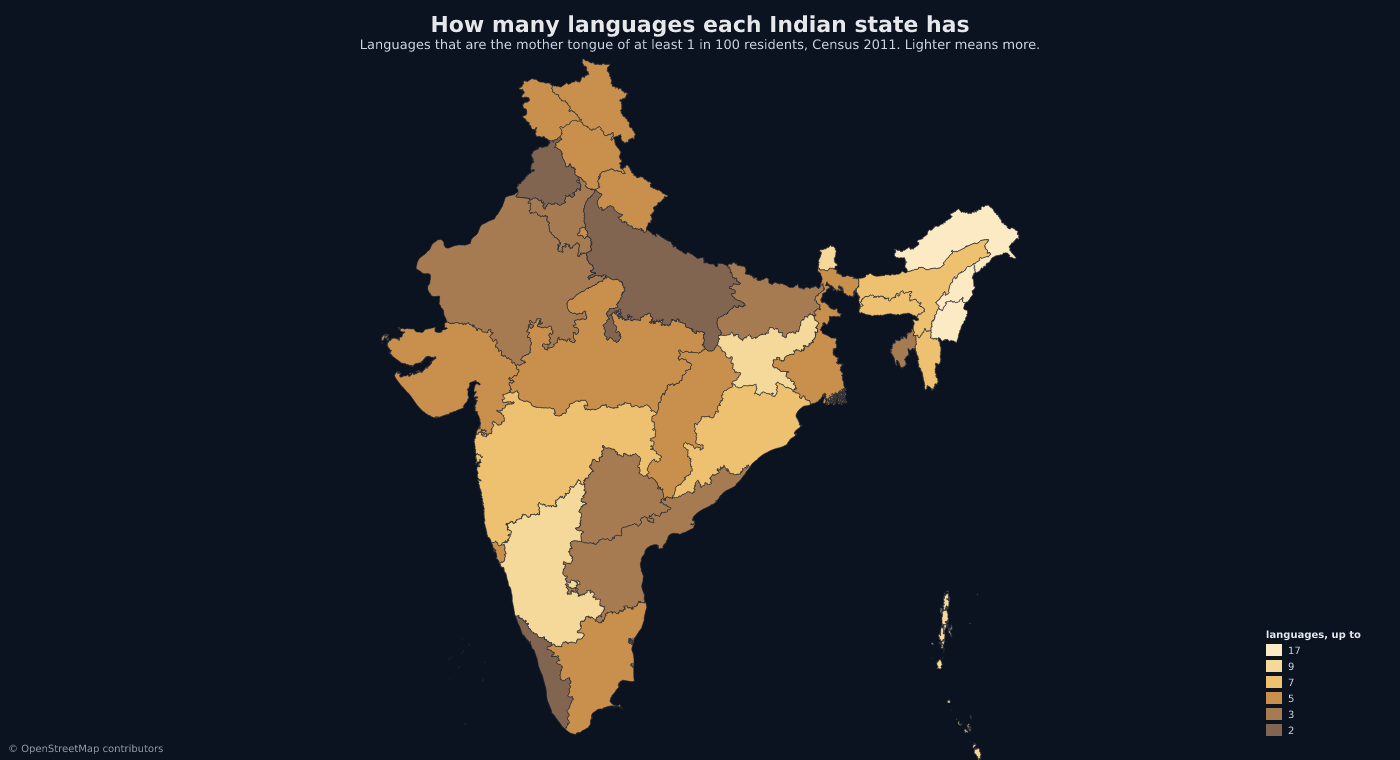
In Nagaland, 17 languages pass 1%. In Kerala, two.
Welcome to Mapped — one dataset turned into one map, every week. This week: how many languages each Indian state has.
In Nagaland, a state of two million people, 17 different languages are each the mother tongue of at least 1 resident in 100. The biggest of them, Konyak, is spoken at home by only 12.3%. Another 12% are filed under “other languages”, ones too small for the census to name.
At the other end of the country, 97.0% of Kerala has Malayalam as its mother tongue. Only one other language, Tamil, reaches 1%.
The map counts, for each state, the languages that are the mother tongue of at least 1% of its people.

Remix this map → Opens this exact map in the editor, data included. Change the numbers, the palette, the threshold. It’s your copy.
What you’re looking at
For each state and union territory, the number of languages that are the mother tongue of at least 1% of its people, from the 2011 Census of India, the latest one to count languages. The lighter the colour, the more languages.
Why 1%? Count every language with any speaker and every state looks diverse: Delhi has 108, and even Kerala has 78, thanks to migrants, students and soldiers from across India. In Delhi only four of the 108 pass 1%: Hindi, Punjabi, Urdu and Bengali.
The pale corner is the Northeast. Nagaland 17, Manipur 14, Arunachal Pradesh 11, Sikkim 9. Most of these are languages of a single people: Konyak, Ao, Lotha and Angami in Nagaland; Tangkhul, Thado and Mao in Manipur; Nyishi, Adi and Wancho in Arunachal, where the biggest language covers only 28.6% of the state.
Outside the Northeast, Karnataka leads with 9. Kannada (66.5%) shares the state with Urdu, Telugu, Tamil, Marathi, Hindi, Tulu, Konkani and Malayalam, a mix of border regions and the migrants of Bengaluru.
The darkest band is the north. Uttar Pradesh, India’s biggest state with 200 million people, has just 2: Hindi (94.1%) and Urdu (5.4%). Punjab, Haryana, Rajasthan and Bihar have 2 or 3.
The catch: what counts as Hindi
That dark north comes partly from how the census sorts languages. People name their own mother tongue, and in 2011 they gave 19,569 different answers. Census linguists merged these into 1,369 mother tongues and then grouped them under 121 languages.
“Hindi” is the biggest of those groups: 528 million people, 44% of India. Only 322 million of them actually answered “Hindi”. The rest named more than 50 other mother tongues that the census files under Hindi, among them Bhojpuri (50.6 million), Rajasthani (25.8 million), Chhattisgarhi (16.2 million) and Magahi (12.7 million). Bhojpuri alone has more speakers than Spain has people.
Many linguists treat Bhojpuri, Magahi and the Rajasthani varieties as languages in their own right. The census follows the Constitution: Maithili sat inside Hindi until it was added to the list of official languages in 2003, and since then it has been counted on its own (13.6 million in 2011). Bhojpuri and Rajasthani speakers have campaigned for the same.
Bihar shows the effect. On the map it has 3 languages, with “Hindi” at 77.5%. But only 25.5% of Biharis answered “Hindi”. 24.9% said Bhojpuri, 10.9% Magahi and 12.4% Maithili.
Other counts
The census’s 121 is the lowest number you will see, because it names only languages with at least 10,000 speakers nationwide. Ethnologue, the standard catalogue of the world’s languages, lists 424 living languages native to India. The People’s Linguistic Survey of India, a volunteer survey led by Ganesh Devy between 2010 and 2013, recorded 780, and says about 100 more could not be documented.
Nagaland’s 17 is probably an undercount. The census recorded only 8,268 speakers of Sümi (Sema), though 236,313 Sümi people live in the state. The gap is close to the 241,000 Nagas filed under “other languages”, which suggests many Sümi answers ended up there. If so, the real count is at least 18.
There is also a way to rank states that does not depend on a cut-off: the “effective number of languages”, which weighs each language by how many people speak it. Nagaland scores 14.1, Kerala 1.06. A 2018 analysis in Mint reached the same two numbers.
The takeaway
India’s diversity is not spread evenly. In the north, one language group covers almost everyone, at least on paper. In the Northeast, a state of two million people can hold 17 languages or more.
Make this map yourself
The whole map is one maproll URL:
https://api.maproll.io/map.svg?scope=IN
  &data=IN-KL:2,IN-UP:2,IN-BR:3,IN-KA:9,IN-AR:11,IN-MN:14,IN-NL:17,...
  &theme=dark
  &classification=custom&breaks=2,3,5,7,9,17
  &legendTitle=languages,%20up%20to
Use India’s state codes (IN-KA, IN-NL, …) for any state-level data. Remix this map → or start from scratch.
Sources: Census of India 2011, Table C-16, Population by mother tongue, one table per state; the count, the shares and the effective number of languages are our own calculations from those tables. Method and totals from the Registrar General’s Paper 1 of 2018: Language. In 2011 Telangana was part of Andhra Pradesh and Ladakh part of Jammu & Kashmir, so each shares its parent state’s value. Languages with fewer than 10,000 speakers nationwide are grouped as “other languages” by the census and are not counted on the map. Sümi population: Census 2011 Scheduled Tribe tables, via Wikipedia. Ethnologue: India; People’s Linguistic Survey of India. Next week on Mapped: subscribe below to get it first.