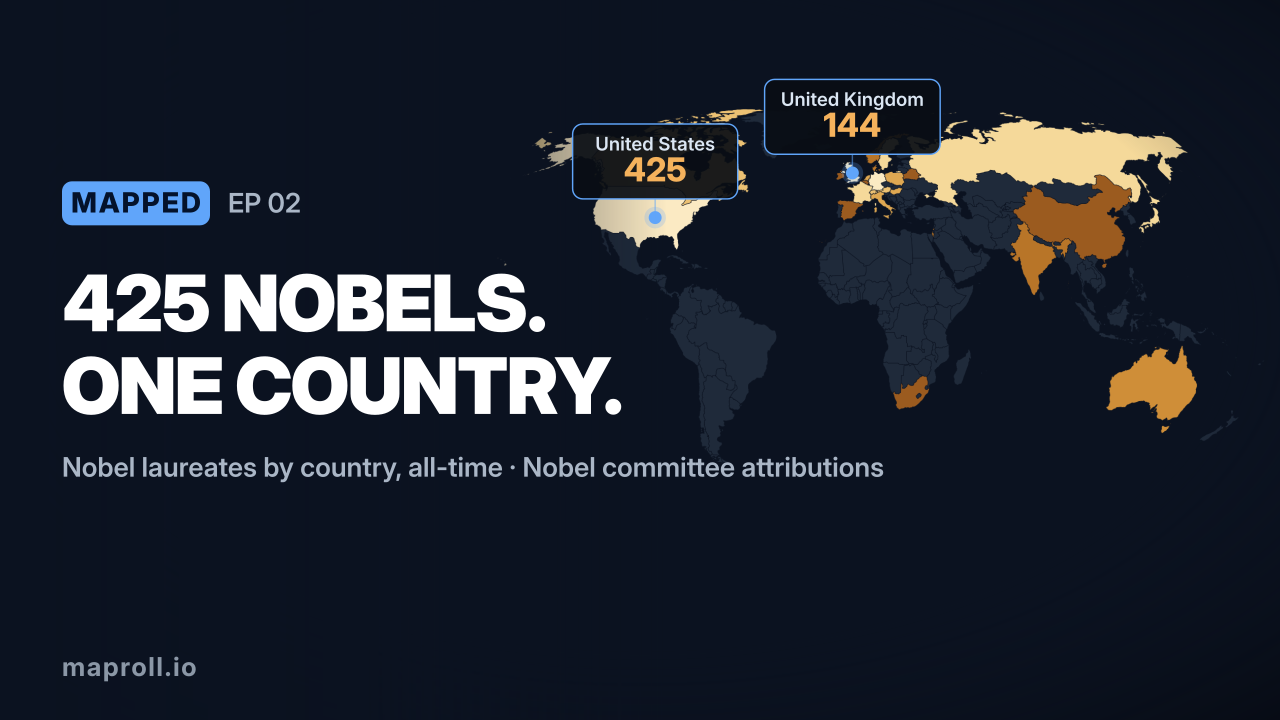
A century of Nobel Prizes, mapped
Welcome to Mapped — one dataset turned into one map, every week. This week: Nobel laureates.
Since 1901, the Nobel Prizes have honoured a few hundred people across physics, chemistry, medicine, literature, peace and economics. Plot them by country and one fact dominates everything else: the United States, with more than 400 laureates, has won more Nobel Prizes than the next four countries combined.

Remix this map → Opens this exact map in the editor, data included. Change the numbers, the palette, the country. It’s your copy.
What you’re looking at
American dominance is a relatively recent story — much of it was built after 1945, as European scientists emigrated and US universities became the centre of global research. Before the war, this map would have been coloured deepest over Germany (116), the United Kingdom (144) and France (78), the old heartlands of European science.
Look for the countries punching far above their size. Switzerland (27), Sweden (34), Austria (25) and Denmark (14) are tiny nations with outsized shelves of medals. On a per-capita basis, Switzerland and the Nordics rival or beat the US outright.
And the map has vast blank spaces. Most of Africa, much of Asia and nearly all of Latin America register only a handful of laureates or none — a map less of talent than of where research money, universities and a century of history have pooled.
The takeaway
The Nobel map isn’t a map of where smart people are born. It’s a map of where the world chose to build its laboratories.
Make this map yourself
This whole map is one maproll URL:
https://api.maproll.io/map.svg?scope=world
  &data=US:425,GB:144,DE:116,FR:78...
  &theme=dark&legendTitle=Laureates
Change the data, pick a different palette, drop it into a report or a tweet. Remix this map → or start from scratch.
Source: List of Nobel laureates by country, attributing each laureate to the country/countries listed by the Nobel committee; Russia includes USSR-era laureates. Next week on Mapped: who really emits the most CO₂.