The US wants a higher tariff on Vietnam than on China
Welcome to Mapped: one dataset turned into one map, every week. This week: the new US tariff list.
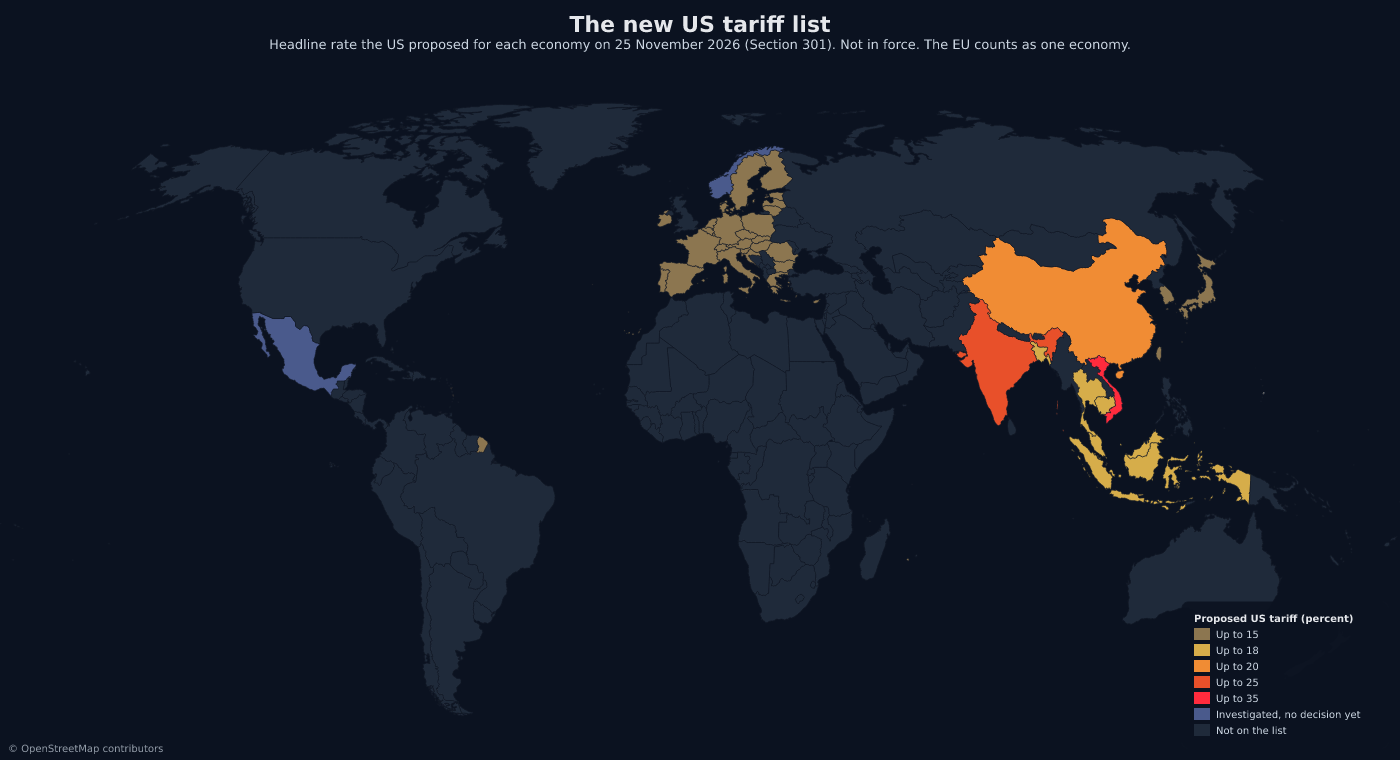
On 25 November, the US Trade Representative named 14 economies it wants to put new tariffs on, and the rate for each. China is on the list, but it isn’t at the top. Vietnam is, at up to 35%. India is next at 25%, and China is at 20%, level with Singapore.
The European Union counts as one economy, so all 27 members share one rate: 15%, the same as Japan, South Korea, Switzerland and Taiwan.
&legendItems=%238c7650%3AUp to 15%3B%23d6ad4a%3AUp to 18%3B%23f08c34%3AUp to 20%3B%23e8502a%3AUp to 25%3B%23ff2b3d%3AUp to 35%3B%234a5a8c%3AInvestigated%2C no decision yet%3B%231f2a3a%3ANot on the list&title=The new US tariff list&subtitle=Headline rate the US proposed for each economy on 25 November 2026 (Section 301). Not in force. The EU counts as one economy.)
Remix this map → Opens this exact map in the editor, data included. Recolour it, change a country, add your own. It’s your copy.
What you’re looking at
Each colour is the headline rate in that economy’s notice. The rates are maximums (“up to”), they cover most but not all goods, and none is in force yet. The fine print below explains how they combine with the duties already in place.
- 35%: Vietnam
- 25%: India
- 20%: China, Singapore
- 18%: Bangladesh, Cambodia, Indonesia, Malaysia, Thailand
- 15%: the EU, Japan, South Korea, Switzerland, Taiwan
Mexico and Norway, in blue, were investigated too, but USTR hasn’t decided on them yet. Grey economies weren’t investigated. That includes the UK, Canada and Australia.
Why now
In February, the Supreme Court ruled that the law Trump used for his worldwide tariffs, the International Emergency Economic Powers Act, doesn’t allow tariffs at all. Collection stopped within days. A temporary replacement under another law expired after its legal limit of 150 days, in July. Since then, the main country-wide tariffs have been 10% or 12.5% on 60 economies, set after an investigation into goods made with forced labour.
This list comes from a second investigation, launched in March, into “structural excess capacity”: the US argues these economies use subsidies, cheap loans and weak labour protections to make far more than they can sell, and export the surplus. The new rates aren’t added on top of the forced-labour tariffs: they include them.
The rates can still move
Most rates come with a second number.
- If talks go well: Vietnam would drop to 20%, India to 17% and Singapore to 10%, if each signs a trade agreement with the US that answers the findings.
- If talks go badly: USTR says it could go up to 40% on China, 25% on Cambodia, Indonesia, Malaysia, Thailand, South Korea and Taiwan, and 20% on Bangladesh, the EU, Japan and Switzerland.
China’s 20% matches the rate Trump and Xi Jinping agreed in Kuala Lumpur in October 2025, its notice says. Some Chinese goods, listed in an annex, would pay 10% instead.
Why Vietnam tops the list
Vietnam’s notice lists more complaints than any other: ten, including transshipment, goods from other countries routed through Vietnam to avoid US tariffs. It also has no finished trade agreement with the US. Bangladesh, Cambodia, Indonesia and Malaysia each have a reciprocal trade agreement with the US, and Thailand has a framework for one. Their notices say the 18% takes those commitments into account.
The fine print
- Not in force yet. Comments are due by 5 January 2027 and hearings start on 25 January. A White House official told CNN the earliest the tariffs would start is January.
- Not quite like for like. For the EU, Japan, South Korea, Switzerland and Taiwan, the 15% includes the normal US import duty. For everyone else, the rate comes on top of it.
- Exemptions. Goods already under the separate Section 232 tariffs, such as steel, aluminium, copper and cars, are exempt. So are some energy, food, chips and medicines, according to CNN.
- On the map: EU members are coloured individually, along with France’s overseas regions, which are part of the EU’s customs territory. Singapore is too small to see at world scale.
Make this map yourself
The whole map is one maproll URL. Each economy gets a class and a colour:
https://api.maproll.io/map.svg?scope=world
  &data=VN:5:#ff2b3d,IN:4:#e8502a,CN:3:#f08c34,TH:2:#d6ad4a,JP:1:#8c7650,...
  &legendItems=#8c7650:Up to 15;#d6ad4a:Up to 18;#f08c34:Up to 20;#e8502a:Up to 25;#ff2b3d:Up to 35
  &theme=dark
Remix this map → or start from scratch.
Sources: USTR, “USTR Makes Determinations and Proposes Actions in 14 Section 301 Investigations” (25 November 2026), and the 14 pre-publication Federal Register notices linked from it: Vietnam, India, China, Singapore, Bangladesh, Cambodia, Indonesia, Malaysia, Thailand, European Union, Japan, South Korea, Switzerland and Taiwan. Background: Congressional Research Service, Active Presidential Tariff Actions in 2026; CNN (25 November 2026). Next week on Mapped: subscribe below to get it first.