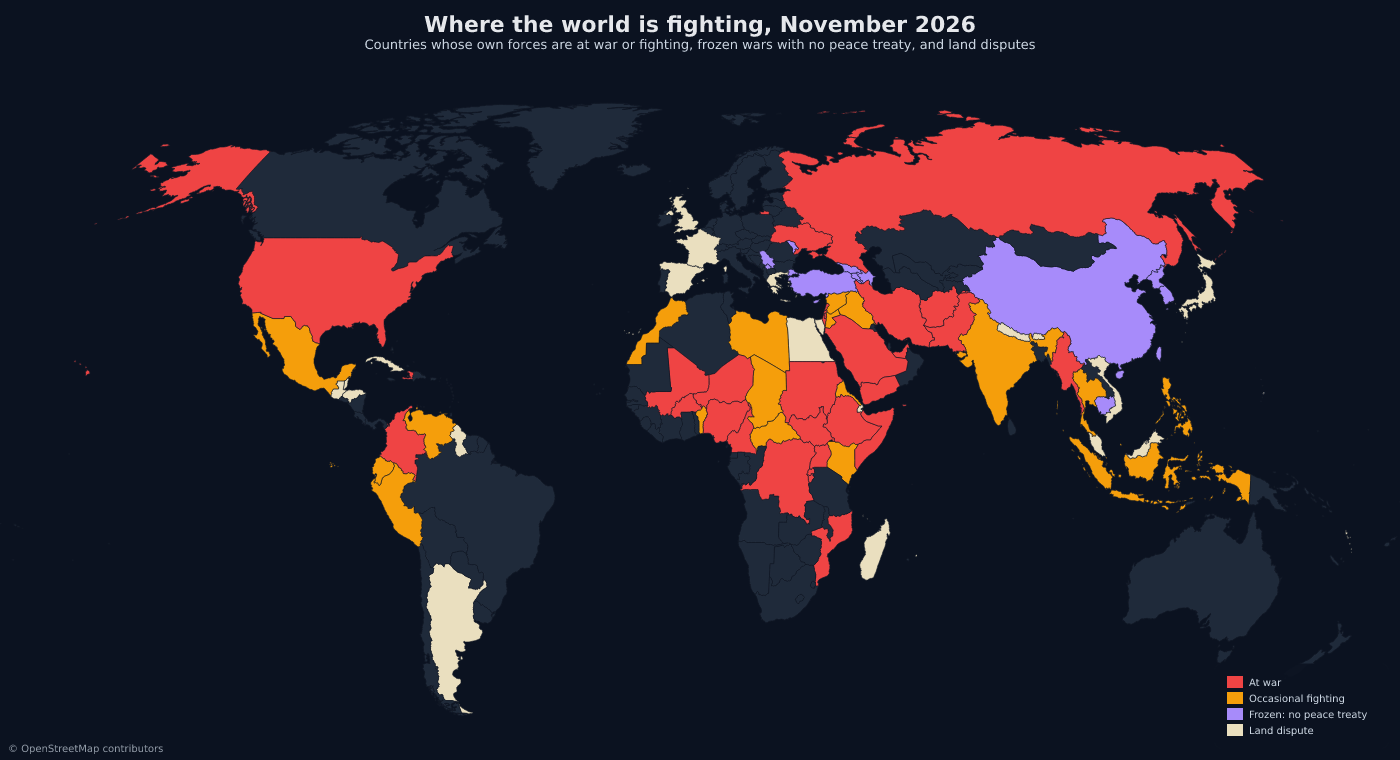
29 countries are at war right now
Welcome to Mapped: one dataset turned into one map, every week. This week: where the world is fighting right now, and where wars stopped without ever ending.
By our count, as of mid-November 2026, the armed forces of 29 countries are at war, either with another country or in a civil war at home. Another 18 see occasional fighting. 13 are stuck in wars that stopped but never ended in a peace treaty, and 22 hold or claim land that another country disputes.
The biggest change this year is a new war. Since 28 February, the United States and Israel have been fighting Iran, and there is still no ceasefire. US strikes hit Iranian islands again in the first week of November.
The rules in one line: a country is coloured by what its own forces do this year, not by being hit, and it takes the most serious colour that applies. There is no official 2026 count yet, so this is our own classification from news and UN reporting up to 11 November, with a source for every country.

Remix this map → Opens this exact map in the editor, data included. Change the colours or the classes. It’s your copy.
Three things stand out:
- Africa has 14 of the 29 countries at war, from Sudan to the Sahel to eastern Congo.
- The Middle East has a new war, the United States and Israel against Iran, while Yemen’s war with Saudi Arabia has restarted.
- The frozen wars cluster in East Asia and around Russia’s borders, where fighting stopped decades ago but no treaty followed.
How to read the map
Each country has one colour, the most serious that applies to it:
- Red, at war: its forces are in sustained fighting this year, against another country or in a civil war or major insurgency at home, and no ceasefire has actually held. 29 countries.
- Orange, occasional fighting: border clashes, limited strikes, or a smaller insurgency with deadly attacks from time to time. 18 countries.
- Purple, frozen: little or no fighting this year, but a war or standoff that never ended in a peace treaty. 13 countries.
- Cream, land dispute: no fighting, but the country holds land another country claims, or claims land another holds. 22 countries.
A country is coloured by what its own forces do. Being hit is not enough: Qatar, Kuwait, Bahrain, Oman, the UK and France shot down Iranian missiles and drones this year, but did not strike back, so they are not red or orange. (The UK and France are cream for land they hold that others claim.) A country can be red for fighting abroad: the United States is red for the Iran war, Rwanda, Burundi and Uganda for their troops in Congo.
There is no official count for 2026 yet. The Uppsala Conflict Data Program, the standard source, publishes a year’s data the following summer. So this map is our own classification, built country by country from news and UN reporting up to 11 November. Every coloured country links to its main source at the end of this post, and the hardest calls are listed below.
The wars
Russia and Ukraine. Still at war, with no ceasefire. The first talks between the United States, Russia and Ukraine in about nine months, in Abu Dhabi on 10 and 11 November, ended without one.
The Iran war. The United States and Israel against Iran since 28 February. A ceasefire in April and a memorandum signed in June both collapsed in July. Iran has fired missiles and drones at Israel and at all six Gulf states. Saudi Arabia struck Iran in March, and the UAE reportedly did too; the UAE has not confirmed it. Qatar, Kuwait, Bahrain and Oman only shot down what was fired at them, so under our rule they are not coloured.
Israel, Gaza and Lebanon. Both fronts have ceasefires that have not stopped the fighting. In Gaza, at least 1,400 people have been killed since the October 2025 truce, and Israel controls about two-thirds of the Strip. In Lebanon, the war that began when Hezbollah opened fire on 2 March has killed more than 4,300 people, and Israeli troops still hold parts of the south.
Yemen and Saudi Arabia. The 2022 truce collapsed in July. The Houthis have hit Riyadh’s airport, killing 13 in October, and Saudi-led strikes hit Sanaa on 7 and 10 November.
Afghanistan and Pakistan. At war since February, after Pakistan declared “open war” on the Taliban government. Two truces did not hold, talks in Moscow failed, and the border fighting went on into November. Pakistan is also fighting the Pakistani Taliban and Baloch insurgents at home.
Africa has 14 of the 29:
- Sudan’s army and the RSF are still fighting, now in the war’s fourth year.
- South Sudan’s power-sharing deal has collapsed, with Ugandan troops backing the government.
- Ethiopia: war resumed on 23 September when a Tigray-led alliance went on the offensive, alongside the Fano war in Amhara. Eritrean troops have been reported inside Tigray, which Eritrea denies; Eritrea is orange.
- DR Congo: the M23 rebels still hold Goma despite two peace deals. A UN experts’ report in July estimated 14,000 to 18,000 Rwandan troops in eastern Congo; Rwanda denies a combat role. Burundi and Uganda also have troops fighting there.
- Somalia against al-Shabaab; Mali, Burkina Faso and Niger against jihadist groups across the Sahel; Nigeria and Cameroon against Boko Haram and ISWAP, plus Cameroon’s separatist war; and Mozambique against an Islamic State affiliate in Cabo Delgado.
Myanmar’s civil war goes on across several fronts.
In the Americas, two wars: Colombia’s forces fight the ELN, FARC dissidents and the Clan del Golfo, and Haiti’s police, army and a UN-authorised force fight the gang coalition that holds most of Port-au-Prince and wants power.
Up close
On the close-ups, only the countries in that story keep their colour. Two more signals appear:
- Black and white: land held by one country and claimed by another, each area with its own pattern.
- Striped colour: when two neighbours fighting each other share a colour, one of them is striped so you can tell them apart.
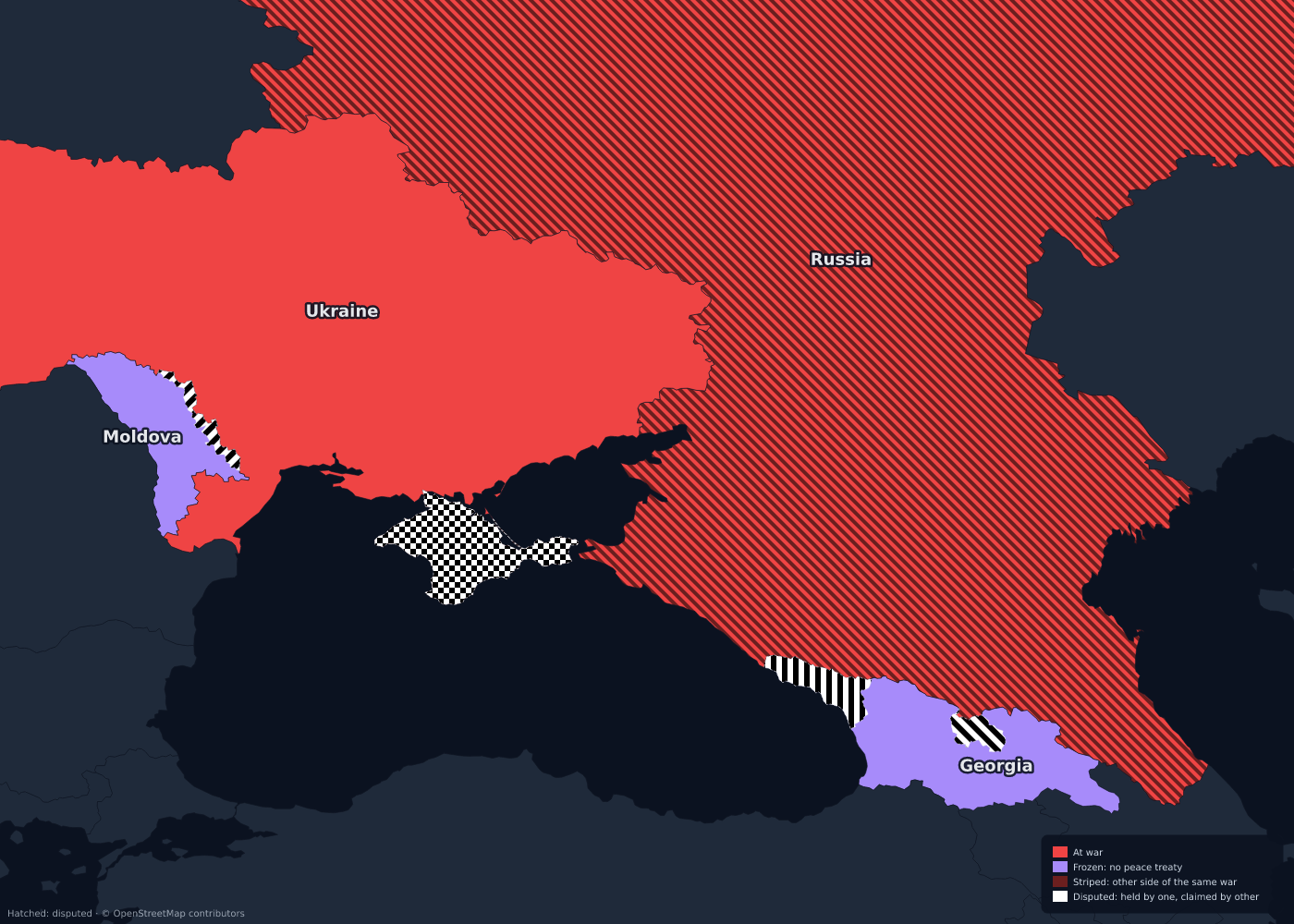
Russia, Ukraine and the frozen wars nearby. Russia (striped) and Ukraine at war. Russia holds Crimea, claimed by Ukraine. Russian-backed authorities hold Transnistria in Moldova, and Abkhazia and South Ossetia in Georgia.
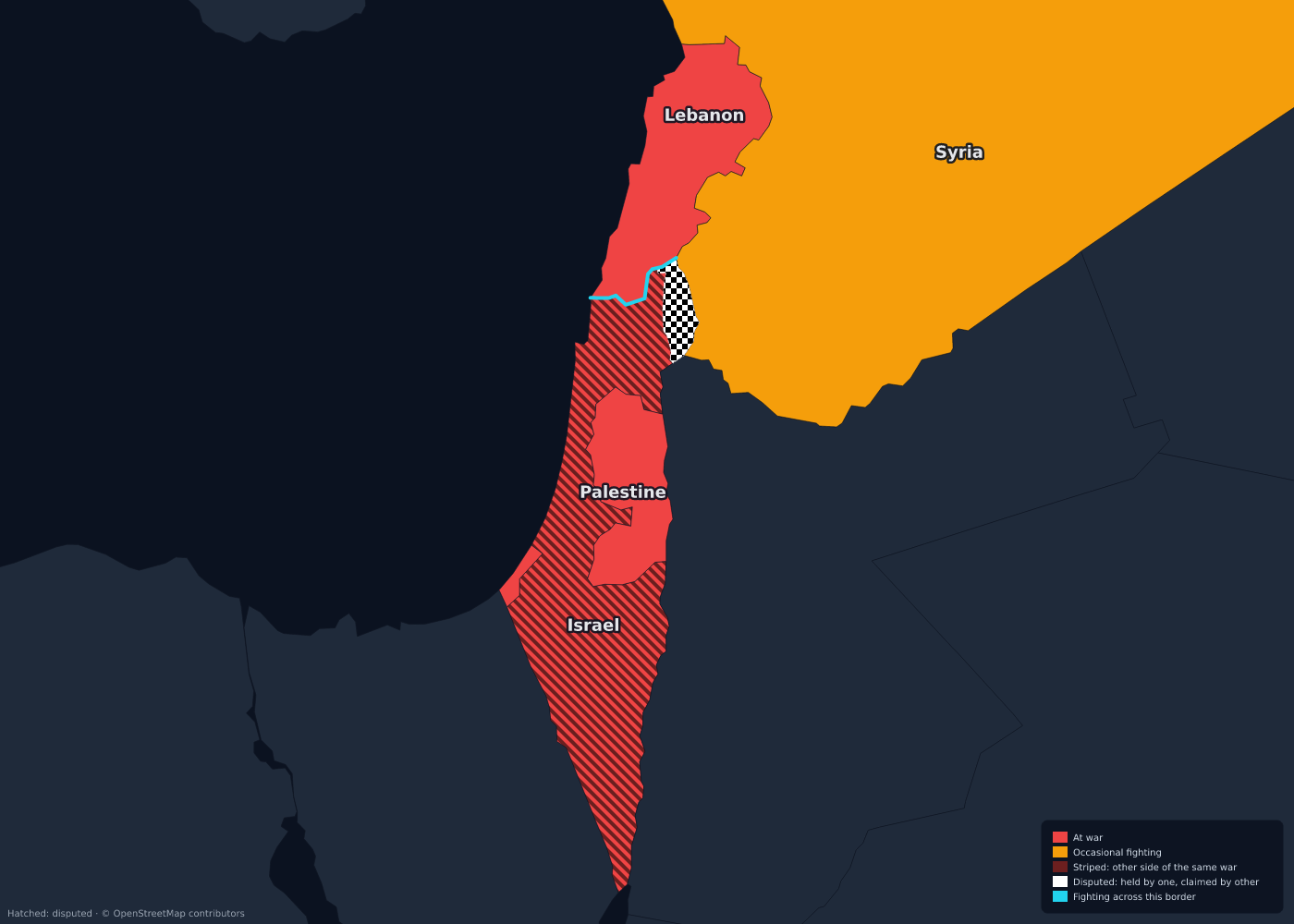
Israel, Gaza, Lebanon and the Golan. Israel (striped) against Hezbollah in Lebanon, across the blue line, and in Gaza. Israel holds the Golan Heights, which Syria claims. Syria is orange for its January offensive against the Kurdish-led SDF.
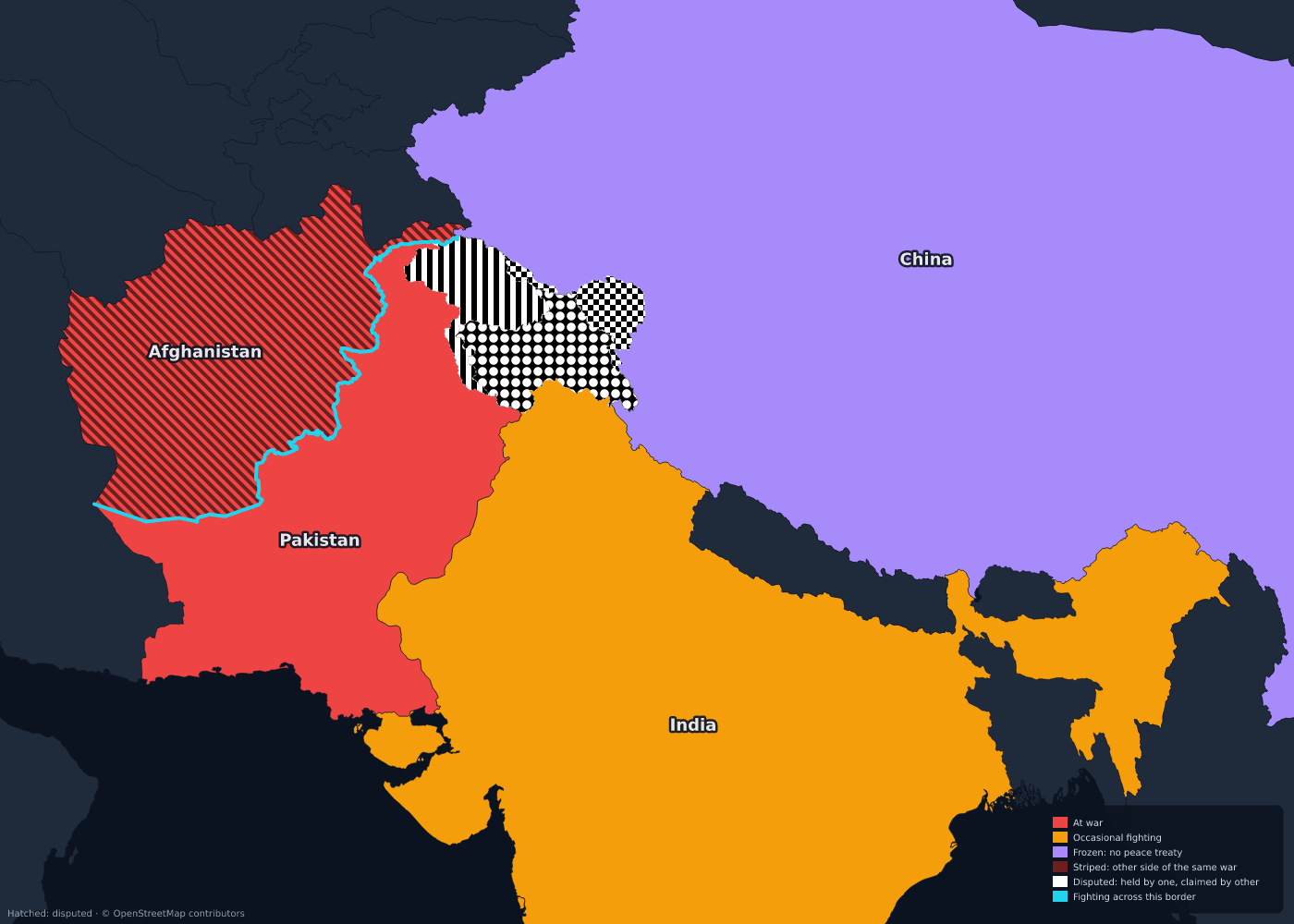
Afghanistan, Pakistan and Kashmir. Afghanistan (striped) and Pakistan at war, fighting along the blue line. Kashmir is split three ways, and each part is claimed by someone else: Pakistan holds the vertical stripes, India the dots, China the checks. India is orange for militancy in Kashmir and ethnic violence in Manipur; there have been no strikes between India and Pakistan since May 2025.
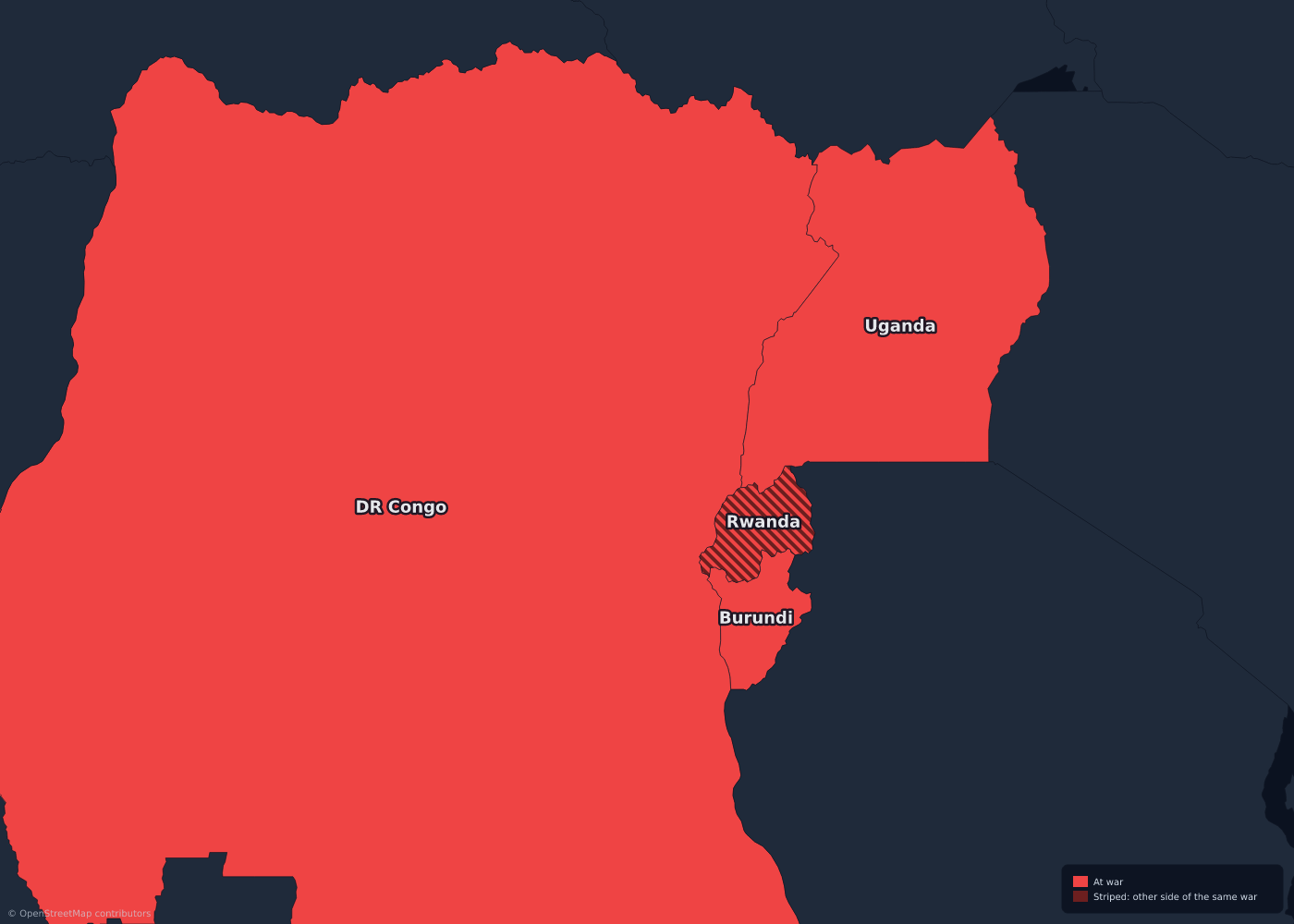
Congo and its neighbours. DR Congo against the M23 rebels, with Rwanda (striped) on M23’s side according to UN experts, and Burundi and Uganda on the government’s.
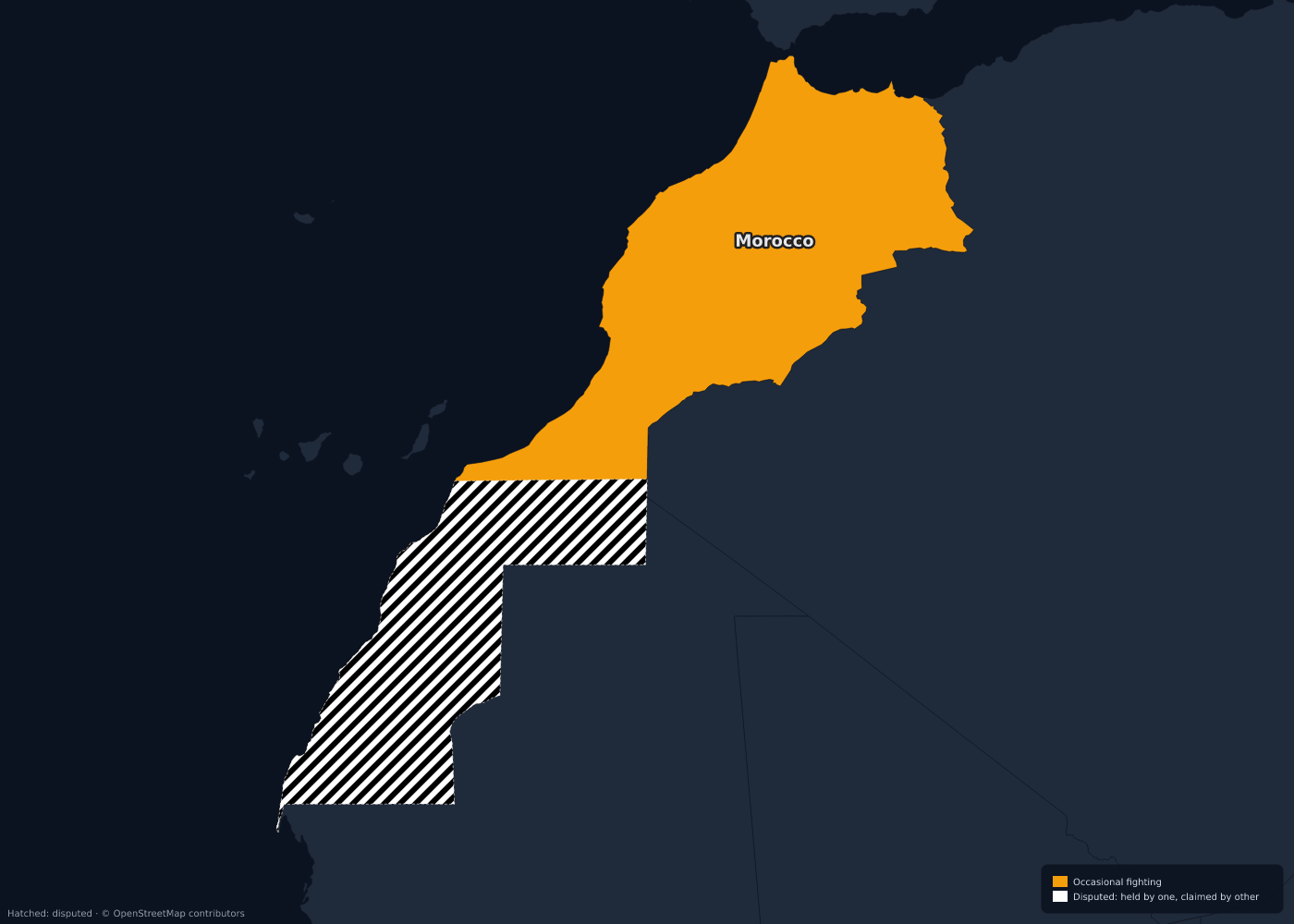
Western Sahara. Morocco holds most of it; the Polisario Front, which claims it, fired projectiles at the town of Smara in May. That makes Morocco orange.
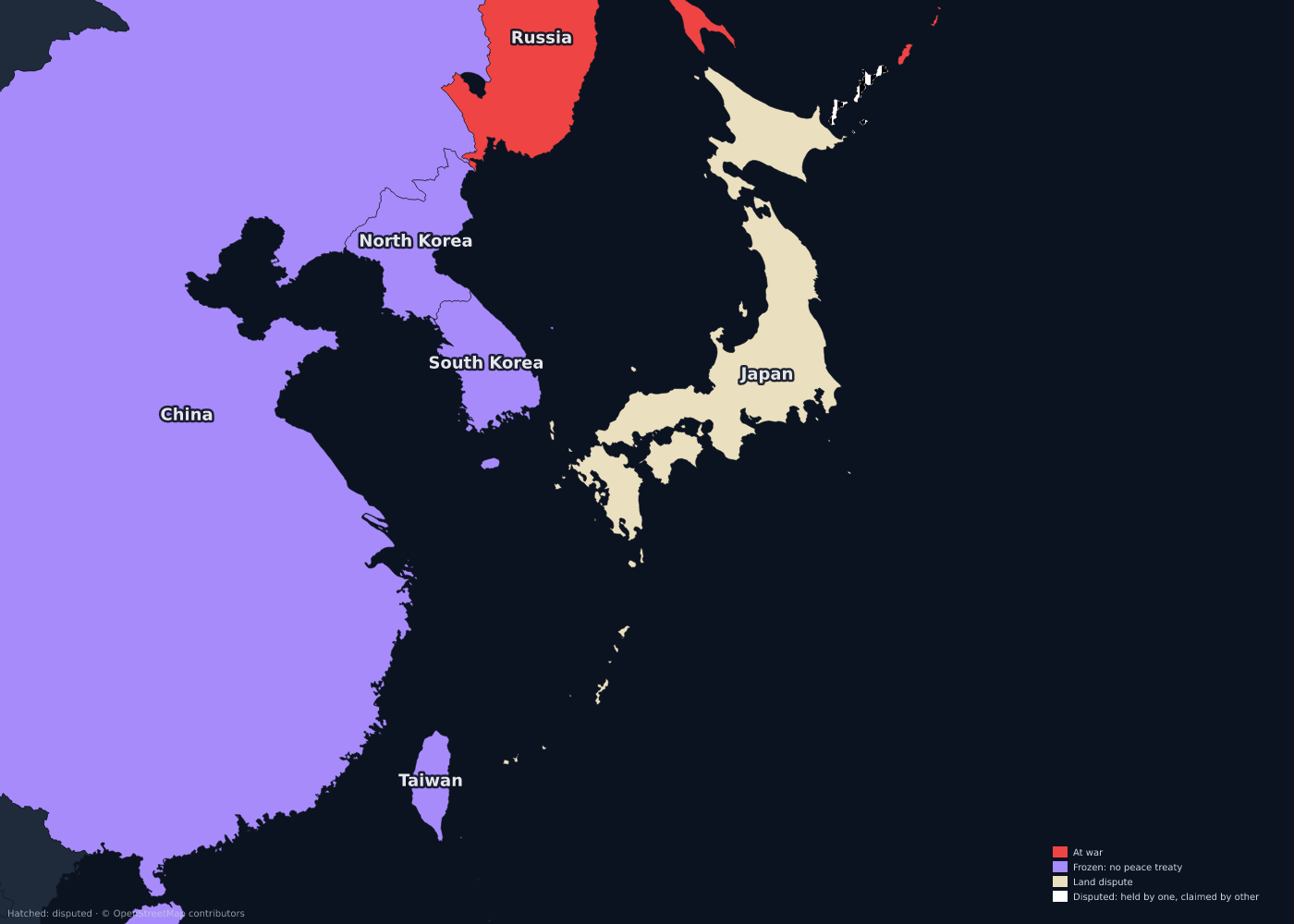
East Asia. The Korean War stopped in 1953 with an armistice, never a peace treaty. China claims Taiwan. Russia holds the southern Kuril Islands, which Japan claims.
Wars that were paused, not ended
- North and South Korea: an armistice since 1953, no treaty. North Korean troops crossed the border line more than 20 times in August and drew warning shots, but no shots were fired back and no one was hurt, which keeps them below our line for occasional fighting.
- China and Taiwan: the Chinese Civil War never formally ended, and China held live-fire drills around Taiwan in October.
- Armenia and Azerbaijan: a peace text agreed in 2025 is still unsigned, pending a change to Armenia’s constitution that Azerbaijan demands.
- Cyprus and Turkey: Turkish troops have held the north of the island since 1974.
- Kosovo and Serbia: Serbia still does not recognise Kosovo.
- Moldova and Georgia: Russian-backed authorities hold Transnistria, Abkhazia and South Ossetia.
- Cambodia and Thailand: they fought over their border twice in 2025. Apart from a stray mortar round in January, which Cambodia called an error, the ceasefire of December 2025 has held and no one has been killed, so Cambodia is purple. The border is still closed. Thailand is orange for its insurgency in the far south.
The land disputes
The cream countries hold or claim land another country disputes, with no fighting this year. The main ones:
- Falkland Islands: held by the UK, claimed by Argentina, which fought a war over them in 1982.
- Essequibo: about two-thirds of Guyana, claimed by Venezuela. The International Court of Justice heard the case in May and has not yet ruled.
- Belize: Guatemala claims about half of it, also before the International Court of Justice.
- The southern Kurils: held by Russia, claimed by Japan.
- Chagos Islands: held by the UK, claimed by Mauritius. The treaty to hand them over is not yet in force.
- Mayotte: French, claimed by Comoros.
- Guantánamo Bay: held by the United States, claimed by Cuba.
- The South China Sea: Vietnam, Malaysia and Brunei claim islands and waters that China also claims. The Philippines is orange for its insurgencies.
The hardest calls
- Gaza and Lebanon are red although both are under ceasefires, because strikes and occupation continued.
- Rwanda is red on the strength of the UN experts’ report, which Rwanda rejects.
- The UAE is red on reports that it struck Iran, which it has not acknowledged.
- Mexico is orange, not red. Its army and National Guard fight heavily armed cartels, but over territory and profit, not over who governs. Ecuador, with gangs, is orange for the same reason.
- Venezuela is orange: on 3 January, US forces raided Caracas and captured President Nicolás Maduro. Venezuelan troops fought back and about 47 were killed. The two have not fought since, and the interim government now works with Washington.
- India is orange, with no single war at that scale this year.
If you think a country is in the wrong colour, reply to this email with a source. We’ll update the map.
Make this map yourself
The whole map is one maproll URL. Each country gets its colour directly, and the legend lists the classes in order:
https://api.maproll.io/map.svg?scope=world
  &data=UA:%23ef4444,IN:%23f59e0b,KP:%23a78bfa,AR:%23eadfbf,...
  &theme=dark
  &legendItems=%23ef4444:At%20war;%23f59e0b:Occasional%20fighting;...
The close-ups add a few settings: bbox crops the map, detail=medium draws sharper coastlines, disputed=CRIMEA,GOLAN,... with disputedStyle=bw draws disputed areas in black and white, patterns=RU:stripes-diagonal stripes a country in its own colour, borders=AF-PK highlights a shared border, and labels=UA,RU with labelText=name writes country names. Remix this map → or start from scratch.
Every country, with its main source
At war: Afghanistan, Burkina Faso, Burundi, Cameroon, Colombia, DR Congo, Ethiopia, Haiti, Iran, Israel, Lebanon, Mali, Mozambique, Myanmar, Niger, Nigeria, Pakistan, Palestine, Russia, Rwanda, Saudi Arabia, Somalia, South Sudan, Sudan, Uganda, Ukraine, United Arab Emirates, United States, Yemen.
Occasional fighting: Benin, Central African Republic, Chad, Ecuador, Eritrea, India, Indonesia, Iraq, Jordan, Kenya, Libya, Mexico, Morocco, Peru, Philippines, Syria, Thailand, Venezuela.
Frozen: no peace treaty: Armenia, Azerbaijan, Cambodia, China, Cyprus, Georgia, Kosovo, Moldova, North Korea, Serbia, South Korea, Taiwan, Turkey.
Land dispute: Argentina, Belize, Bhutan, Brunei, Comoros, Cuba, Djibouti, Egypt, France, Greece, Guatemala, Guyana, Honduras, Japan, Madagascar, Malaysia, Mauritius, Nepal, Spain, UK, Vanuatu, Vietnam.
Sources: our own classification of each country as of 11 November 2026, from news and UN reporting; each country’s main source is linked above. The 175 sources behind the colours come from Al Jazeera, Africanews, WTOP (AP), the Council on Foreign Relations, Euronews and Critical Threats and others. Disputed areas are drawn from OpenStreetMap. Borders on the map show who controls the ground, not who has the right to it. Next week on Mapped: subscribe below to get it first.